
ΕΙΔΗΣΕΙΣ
A Tale of Two Germanys
BY TILL HOPPE, DONATA RIEDEL, RUTH BERSCHENS AND HANS-PETER SIEBENHAAR
Amid far-right protests and arson attacks, the German government is freeing up €1 billion to manage the refugee crisis and limit the flow of economic refugees from the Balkans.
There’s a “bright Germany” consisting of the many volunteers helping refugees. And there’s a “dark Germany that we feel when we hear of attacks against asylum-seekers’ hostels or xenophobic assaults on people,” he said while visiting a refugee center in western Berlin on Wednesday.
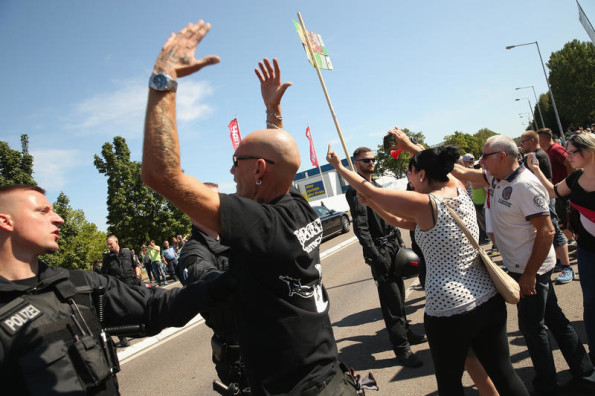
While he was speaking, Chancellor Angela Merkel entered that “dark Germany” in Heidenau, a small townin the eastern state of Saxony where 31 police officers were injured in anti-refugee protests over the weekend.
Heckled and booed by about 50 protesters, some of whom were waving signs that said “traitor,” the chancellor spoke to some of the 400 asylum-seekers living in cramped, uncomfortable conditions in a former DIY store.
She told reporters and local people: “There is no tolerance for those people who question the dignity of others, no tolerance for those who are not willing to help where legal and human help is required.”
Vice Chancellor Sigmar Gabriel, the leader of the Social Democrats, had visited the same refugee center on Monday, where he said far-right radicals had no place in Germany.
The SPD, which is the junior partner in the ruling right-left coalition, was then inundated with hate mail and its party headquarters in Berlin had to be evacuated on Tuesday after a bomb threat.
There have also been a number of arson attacks on refugee centers across the country over the past week, most recently in Nauen, a town east of Berlin.
Amid the heightened tensions, these visits by Germany’s top politicians were important signals that the refugee crisis is taking top priority.
But symbolic gestures alone won’t help the cities and districts across Germany struggling to cope with the arrival of 1,000 to 2,000 migrants each day. On Wednesday, the government signaled it was taking concrete steps to address the crisis by freeing up additional cash and creating measures to deter economic migrants and speed up the provision of housing.
“The rapidly increasing number of refugees in Germany is without doubt the mega task of the coming years,” Deputy Finance Minister Jens Spahn told Handelsblatt. “All other public spending wishes must be subordinate to it. That is why all additional (fiscal) room for maneuver we get should first be devoted to added spending in this field.”
That’s a clear statement: the government has identified the migrant crisis as its number one task. At Wednesday’s cabinet meeting, the government decided to make an additional €1 billion, or $1.14 billion, available to municipalities and rural districts inundated with refugees, and it is getting more money ready.
Mr. Spahn pointed out that the Bundesbank, Germany’s central bank, expects federal government tax revenues this year to be around €5 billion higher than expected. Wolfgang Schäuble, the finance minister, made clear on Tuesday that Germany won’t have difficulty funding its response to the crisis. “We can manage the developments,” he said.
Meanwhile, Interior Minister Thomas de Maizière is hammering out a plan to cope with the expected total of up to 800,000 asylum-seekers coming to Germany this year.
Those measures include doubling the time refugees spend in large initial registration centers to up to six months so that their requests can be handled on the spot and they can be sent back home again more easily if rejected. Another controversial plan is to cut cash payments to migrants who are likely to be sent back home because their countries are deemed safe. This will likely apply to migrants coming to Germany from Balkan nations such as Albania, Kosovo and Montenegro that account for at least 40 percent of all the asylum-seekers.

Any money paid out will only be made available for one month in advance to avoid giving false incentives to asylum-seekers, said a paper drafted by the interior ministry.
Some of the measures are running into opposition from the center-left Social Democrats. They reject extending the time spent in refugee centers and instead want to see the Federal Office for Migration and Refugees hire more staff.
Ms. Merkel’s spokeswoman, Christiane Wirtz, stressed on Wednesday that the entire German government, not just one or two ministries, was working to cope with the enormous challenges posed by the influx of refugees.
Ms. Merkel will host a meeting of officials from the federal government and the 16 regional states next month to resolve a dispute over funding the accommodation, provisioning and administrative processing of refugees.

One option being discussed is that the federal government should pay local authorities a fixed sum per refugee. Mr. Spahn, the deputy finance minister, said the government would not be transferring all its extra tax revenues to local authorities because it also needed to invest in its own agencies including the Federal Labor Agency, which will play a major role in finding work for asylum-seekers who are allowed to stay.
“In my constituency the manager of a big logistics company told me he could hire 500 refugees at once, he just didn’t know who to call about it,” said Mr. Spahn.
Other measures planned include exempting refugee accommodation from strict fire protection and energy saving regulations so that buildings can be made available more quickly to handle the influx.
Separately, in a bid to deal with the spike in racist and anti-refugee comments online, the German justice minister, Heiko Maas, is reported to have written to Facebook asking it to be more vigilant in dealing with hate speech. According to Der Tagesspiegel daily, the minister has invited representatives from the company to meet with him on September 14 to discuss “ways of improving the effectiveness and transparency of your community standards.”
Meanwhile, the crisis appears to be loosening the gridlock in the European Union’s asylum policy. Commission President Jean-Claude Juncker plans to propose a list of safe countries of origin in September, and all the Western Balkan countries will be on it, said Commission sources. That should make it possible to send migrants from those countries back as quickly as possible.
Frontex, the E.U.’s border management agency, is to get a stronger role in returning rejected asylum-seekers, but its mandate will have to be widened to make that possible.
The Commission is also sticking to its plan to distribute some of the migrants across the E.U. member states via a quota system. That would replace the bloc’s so-called Dublin Regulation that states asylum claims must be handled in the country where migrants first arrive or first request protection. In practice, that system is being circumvented because Greece and Italy are waving many refugees through to allow them to seek asylum in Germany, Sweden or Austria.
The United Nations estimates that around 3,000 refugees are passing the Greece-Macedonia border each day. Many are now rushing to reach E.U. member Hungary before it completes the fence it is currently erecting along the border with Serbia.

The German government has bowed to this reality by allowing Syrian refugees coming through Italy or Greece to officially file for asylum in Germany. That decision marked the beginning of the end of the Dublin Regulation, said officials in Brussels.
Meanwhile, migration from the West Balkans is expected to top the agenda of a conference in Vienna today of Balkan leaders, joined by Austrian Prime Minister Werner Faymann, Ms. Merkel and the E.U. foreign policy chief Federica Mogherini.
“We’re trying to make clear to people that every asylum-seeker will be sent back,” Albanian Foreign Minister Ditmir Bushati told Handelsblatt.
Serbia and other countries in the region like Bosnia-Herzegovina, Kosovo, Albania, Montenegro and Macedonia want a close partnership with Germany under the so-called “Berlin Process” that was initiated by Germany last year and is seen by many as pursuing their eventual accession to the European Union.
“To be honest the most important goal of all involved must be political and economic stability in the Balkans,” Serbian Prime Minister Aleksandar Vucic told Handelsblatt. “That’s why Serbia and the other countries of the region need political support.”
The Vienna conference will decide a number of infrastructure projects totaling €600 million, according to Goran Svilanovic, head of the Regional Cooperation Council for southeast Europe.
The German government is providing €1 million in immediate aid for refugees in Serbia and Macedonia, two of the most important transit countries for refugees, many of whom are from Syria, trying to get to the richer nations of northern and western Europe. The money is to help pay for food, blankets and sleeping bags.
Florian Hahn, foreign policy spokesman for the Christian Social Union, the Bavarian sister party to Ms. Merkel’s CDU, said: “It’s not enough to give the countries a vague prospect of accession. The E.U. must invest more and coordinate the aid better. But the help can only work if the Balkan countries cooperate.”
The prime minister of Montenegro, Milo Dukanovic, told Handelsblatt he was committed to speeding up reforms in his country. But he added: “There’s no doubt that we have very serious problems with organized crime and corruption in the Western Balkans.”
Till Hoppe is Handelsblatt’s foreign policy correspondent, based in Berlin. Donata Riedel covers economic policy for Handelsblatt. Ruth Berschens is head of the paper’s Brussels bureau. Hans-Peter Siebenhaar is the Vienna correspondent. To contact the authors: hoppe@handelsblatt.com, riedel@handelsblatt.com,berschens@handelsblatt.com, and siebenhaar@handelsblatt.com
https://global.handelsblatt.com/edition/250/ressort/politics/article/a-tale-of-two-germanys


σχόλια
Πρέπει να είστε μέλος για να αναρτήσετε σχόλια. - Συνδεθείτε εδώ